
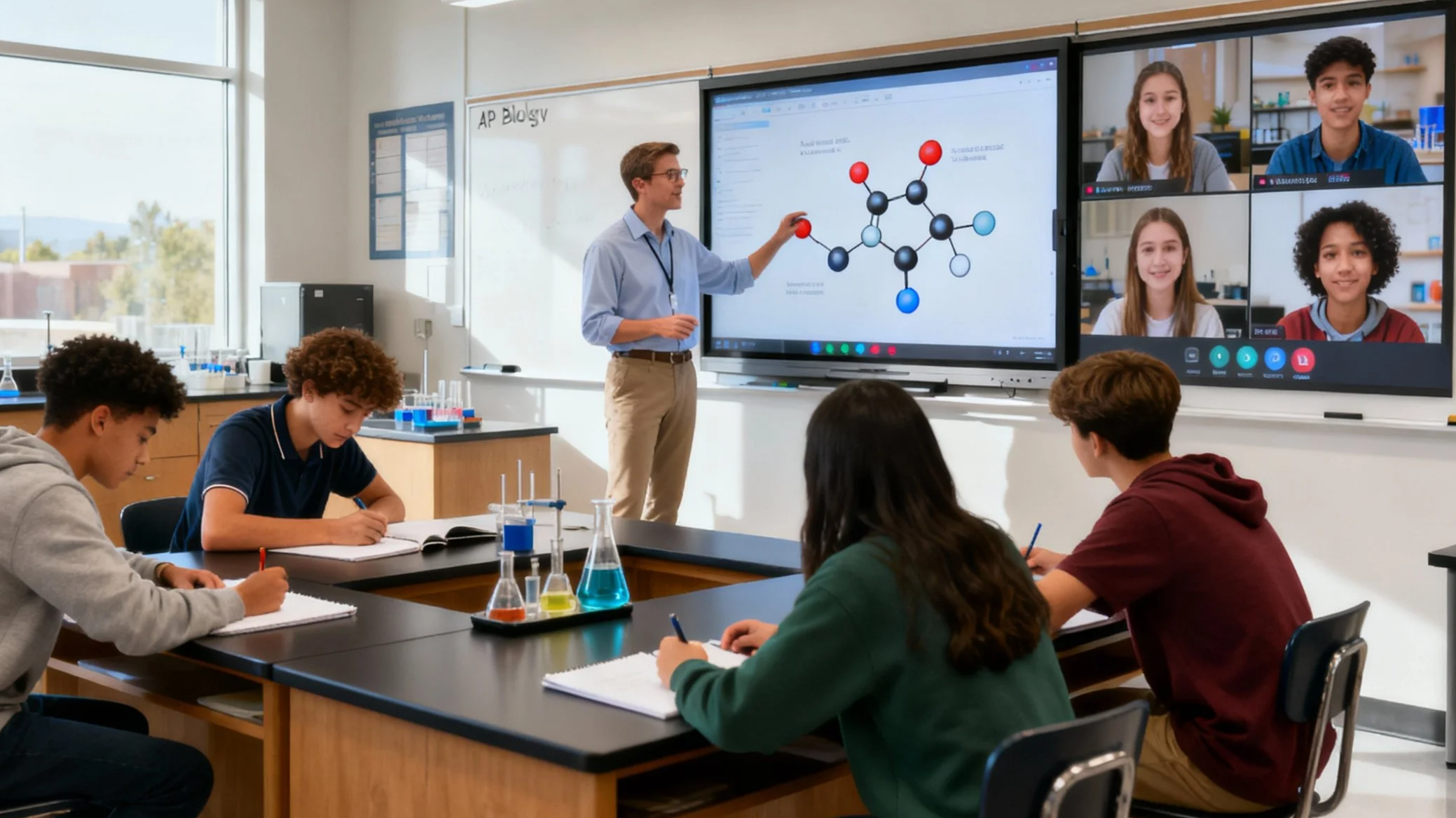
What if your district could generate millions in new revenue, expand course access to underserved students, and solve staffing shortages—without hiring a single new teacher?
Superintendents face an impossible math problem every year. Five students need AP Computer Science. Eight want Mandarin. A dozen are ready for advanced physics. But hiring specialized teachers for small cohorts means spending $80,000+ per position—money most districts don't have.
The reality is stark: as of 2025, approximately 411,500 teaching positions in the United States are either vacant or filled by instructors without full certification, with STEM fields hit hardest. Forty-one states report science teacher shortages, and rural districts face the most acute challenges due to smaller tax bases and distance from teacher preparation programs.nationalacademies
There's a third option that flips this equation entirely: district-led statewide course sharing.
What Is District-Led Course Sharing?
District-led course sharing transforms your existing teachers into revenue generators by opening empty seats in grades 6–12 classrooms to students from other districts.
Here's how it works:
Your teacher continues teaching your enrolled students exactly as they do now
Students from partner districts join remotely via hybrid instruction during the same class period
Your district earns $500–$1,250 per remote student or $10,000–$25,000 when another district sends a full cohort
Zero additional teaching staff required for secondary programs—you're monetizing capacity that already exists
This isn't vendor-provided online content with faceless instructors. This is your award-winning AP Bio teacher reaching 40 students instead of 12, with 28 of those students funded by outside districts willing to pay premium rates for quality instruction they can't provide themselves.
Why District-Led Course Sharing Works Now
Higher Education Already Proved the Model
Pennsylvania's State System of Higher Education launched an intercampus course-sharing initiative in 2025, allowing students to take advanced or specialized courses from other universities without leaving their home campus. Texas implemented a statewide course-sharing pilot in fall 2023 with ten participating institutions, expanding to fifteen more in fall 2024.
These programs demonstrate that course sharing increases student access, prevents program closures, and generates sustainable revenue streams.
Rural Districts Desperately Need Solutions
Research from 2024-2025 shows rural students have access to fewer overall classes and far fewer high-level courses than students in suburban and urban districts. Rural schools face inadequate funding that restricts their ability to offer STEM programming or qualified educators to provide instruction.
More than 13% of rural households lack the minimum broadband connection for streaming educational videos or virtual classrooms, compared to 9.9% across all locales. State virtual schools like Montana Digital Academy and Idaho Digital Learning have provided supplemental online courses for over a decade to address these gaps.
Technology Infrastructure Has Matured
Hybrid learning models now successfully blend online and in-person education, with students alternating between on-site attendance and remote participation while maintaining full credit and funding. The infrastructure most districts deployed during the pandemic now enables sophisticated course-sharing arrangements that weren't feasible five years ago.
The Revenue Model: Conservative Projections, Significant Returns
Let's talk numbers, because this only works if the economics make sense.
Per-Student Enrollment Model
Small partner districts pay $500–$1,250 per student to enroll 2–5 learners in your courses.
Example calculation: If you open 20 courses and average just 4 outside students per course at $800 each, that's $64,000 in Year One from minimal effort.
Per-Course Cohort Model
Districts needing an entire section pay $10,000–$25,000 to send 15–25 students.
Example calculation: Just five partner agreements at $15,000 each generates $75,000 annually per participating teacher.
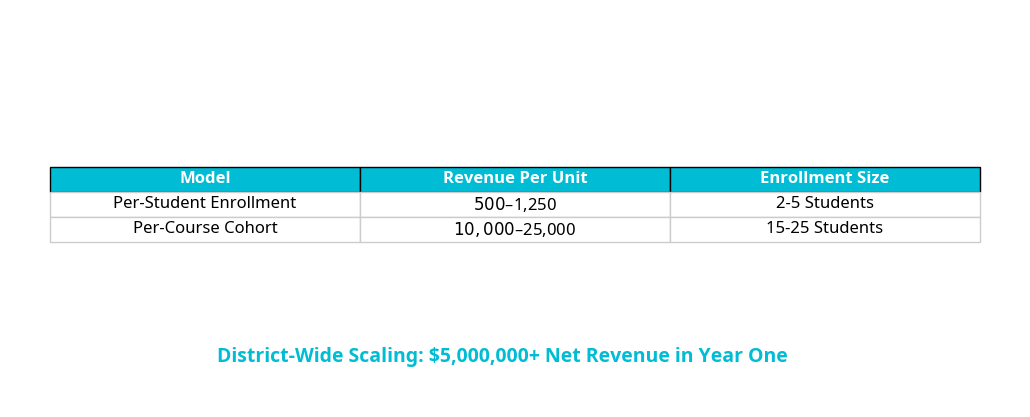
District-Wide Revenue Scaling
Conservative projections for a mid-sized district suggest $5 million net revenue in Year One, scaling to $15–20 million by Year Two as reputation builds and enrollment expands. This revenue funds the 250 highest-earning teachers, technology infrastructure, professional development, or any strategic priority your board identifies.
The operational lift is minimal. No additional teaching resources for secondary programs. Each teacher departure already costs districts $12,000–$25,000 in recruitment and training —course sharing generates revenue instead of draining it.
How Course Sharing Solves the Education Equity Crisis
The Rural Access Problem
Rural districts face a cruel reality: low enrollment numbers prevent them from offering advanced coursework, limiting college prep opportunities for their students.
A rural district with three students interested in AP Statistics doesn't need to hire a $75,000 teacher. They need those three students to access quality instruction somewhere—anywhere—at reasonable cost.
The Course Sharing Solution
Course sharing creates that access. Your district becomes the provider. Those three students enroll in your section for $750 each. Your AP Stats teacher gains three engaged learners. The rural district fulfills its equity mission. And your district earns $2,250 with zero marginal cost.
State virtual schools already demonstrate this model's viability. Wisconsin Digital Learning Collaborative, for example, provides a single point for schools to access quality online courses through partnerships that lower per-student costs through economies of scale.
Measurable Impact on Access
Higher education course-sharing networks report over 17,000 enrollments in 2023-2024, demonstrating significant unmet demand for specialized instruction. K-12 districts face even greater demand because college admissions increasingly scrutinize course rigor and advanced placement credits.
What Makes Your District's Course Offering Valuable
Instructional Quality Over Generic Content
Families and partner districts pay premium rates to access your proven teachers rather than settle for generic online content. Higher education course-sharing networks report over 17,000 enrollments in 2023-2024 precisely because students value institutional credibility.
Live Instruction Over Recorded Videos
Real-time interaction, immediate feedback, and relationship-building that recorded video courses can't replicate. Students engage with actual teachers who know their names, track their progress, and adjust instruction based on live assessment.
District Credibility for College Admissions
Transcripts show courses taught by accredited public school districts, not for-profit vendors, which matters for college admissions and NCAA eligibility. Admissions officers recognize district-issued AP or dual enrollment credits as legitimate advanced coursework.
Teacher Benefits and Professional Growth
Fuller classes, professional recognition beyond district boundaries, and compensation tied to enrollment growth that rewards excellence. Teachers gain visibility as subject matter experts and can build reputations that attract additional enrollment.
Step-by-Step Implementation Guide
Step 1: Identify High-Demand Courses
Focus on courses with documented shortages: AP classes, upper-level STEM, world languages beyond Spanish, and specialized electives like forensics, engineering, or computer science.
Forty-one states report science teacher shortages, making AP Physics, AP Chemistry, and AP Biology prime candidates.
Step 2: Assess Your Technology Infrastructure
Most districts already have the necessary components:
Reliable video conferencing (Zoom, Google Meet, Microsoft Teams)
A learning management system (Canvas, Google Classroom, Schoology)
Teachers comfortable with hybrid delivery after pandemic-era remote instruction
If gaps exist, infrastructure upgrades can be funded from projected first-year revenue before launching additional courses.
Step 3: Model State-Specific Revenue Projections
Schedule a 15-minute planning session to review your course catalog and generate enrollment projections based on demand patterns in your region. Different states have different course-sharing regulations and funding formulas that affect revenue models.
Step 4: Establish Partner District Agreements
Start with 2–3 neighboring districts facing staffing shortages. Texas's course-sharing pilot developed standardized processes and protocols with ten institutional partners before expanding. Pennsylvania created a course-sharing guide specifically to help other systems replicate their model.
Draft inter-district agreements that specify:
Enrollment processes and deadlines
Per-student or per-course fee structures
Credit transfer and transcript procedures
Technology requirements for participating students
Liability and compliance responsibilities
Step 5: Market Your Course Offerings to Partner Districts
Partner districts need to know you exist. A focused outreach strategy includes:
Direct emails to superintendents in districts with documented course gaps
Presentations at regional superintendent meetings and state education conferences
Listings on state education agency course-sharing directories
Digital marketing to parents in surrounding districts seeking advanced coursework
Wisconsin's model succeeded by creating a single point of access where districts could easily discover available courses and enrollment processes.
Frequently Asked Questions About Course Sharing
Who pays the instructor's salary?
Your district continues paying your teacher their regular salary. Revenue from partner districts flows to your general fund or dedicated accounts to offset costs and fund strategic initiatives.
What about teacher workload concerns?
Teaching 28 students instead of 12 doesn't double prep time—the curriculum remains the same. Some teachers welcome fuller classes because they provide more dynamic discussions and peer learning. Others appreciate stipends for sections exceeding normal enrollment caps, which can be funded from outside-district revenue.
How do credits and transcripts work?
Students enroll through inter-district agreements similar to transfer students or dual enrollment programs. Your district issues the transcript showing coursework completed with your teacher.
Pennsylvania's model allows students to earn full credit remotely rather than lose out on specialized courses or travel hours to attend in person. Partner districts accept these credits just as they would accept transfer credits from any accredited public school.
Can districts start with a small pilot?
Absolutely. Most successful programs pilot with 2–3 courses and one teacher volunteer. Texas started with ten institutions and expanded after proving the model and refining operational procedures.
Pilot programs allow you to:
Test technology infrastructure with low stakes
Develop enrollment and communication workflows
Train staff on inter-district coordination
Gather data on student outcomes and teacher satisfaction
Build case studies for scaling to additional courses
How long does implementation take?
Districts can move from concept to launch in 2 weeks with focused effort. Pennsylvania's State System announced their course-sharing initiative and began implementation within a single semester. The timeline depends on:
Existing technology readiness
Number of partner districts seeking agreements
Teacher recruitment and training needs
Why First-Mover Advantage Matters Now
Competition Is Coming
Pennsylvania, Texas, Missouri, and Hawaii systems have already implemented course-sharing initiatives. Districts that establish statewide programs now will capture market share and lock in partner agreements before regional competitors enter the space
Teacher Shortages Aren't Improving
Teacher attrition accounts for 90% of annual teacher demand, with fewer than one-fifth of departing teachers actually retiring. The pipeline problem isn't solving itself—approximately 411,500 teaching positions remain vacant or filled by instructors without full certification.
Course sharing doesn't just address shortages—it creates new revenue streams from existing assets while improving teacher retention by offering professional growth opportunities and fuller classes.
College Admissions Pressure Is Increasing
As selective colleges return to standardized testing requirements and scrutinize transcript rigor, students need access to AP courses and advanced STEM classes to remain competitive. Districts that can't offer these courses risk losing enrollment to charter schools, online academies, and neighboring districts with more comprehensive catalogs.
Take the Next Step: See Your District's Revenue Potential
Your teachers are ready. Your courses are proven. The technology exists. The regulatory frameworks are established through higher education models. The demand is waiting.
The only question is whether your district will lead—or watch others capture the revenue and impact that could have been yours.
Schedule a 15-minute planning session to review your course catalog, identify high-demand offerings, and see state-specific revenue projections.
[Book Your Planning Session →]
What you'll get:
Customized revenue projections based on your course catalog
State-specific regulatory guidance and compliance requirements
Implementation timeline with key milestones
Example partner district agreements
Technology infrastructure checklist
No preparation required. No commitment expected. Just a straightforward conversation about whether this model fits your district's goals and capacity.
Key Takeaways: District-Led Course Sharing
411,500 teaching positions in the US remain vacant or insufficiently filled, with STEM and rural districts hardest hitwinssolutions
Course sharing generates $500–$1,250 per student or $10,000–$25,000 per cohort in outside-district revenueivybound
Conservative projections show $9M Year One revenue for mid-sized districts, scaling to $15–20M by Year Twoivybound
Zero additional teaching staff required for secondary programs—you monetize existing capacityivybound
Pennsylvania, Texas, Missouri, and Hawaii already implemented successful models at the higher education leveldltx.highered.texas+2
72% of parents are actively considering new school options, creating significant demand for hybrid and specialized instructiondiscovery
90-day implementation timeline from concept to launch for pilot programsivybound
Revenue projections depend on enrollment, course mix, state regulations, and implementation pacing. Request a customized model during your planning session.
